Pocket Park or Open Square: Two Different Uses of Small Public Space
Compare a pocket park and an open square by how each supports pausing, moving and gathering, so you can read a small public space with clearer eyes.
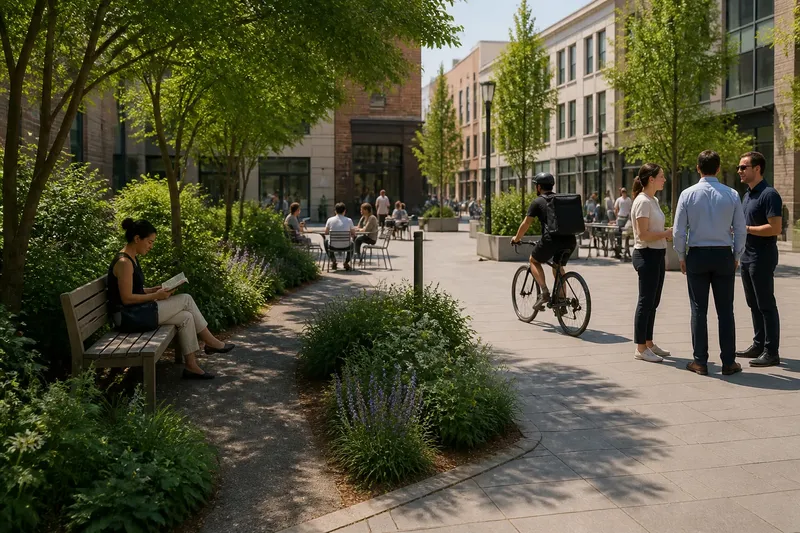
At lunchtime, one person slips into the shade beside a planting bed while a delivery cyclist cuts across the paving and a few coworkers stand talking near the edge. A pocket park or open square makes those ordinary choices feel different, even when both occupy a modest city lot. To read what a small public space is designed to invite, look first at its ground, then at its edges, and finally at how people use the room it creates.
Start with the shape of the ground
A pocket park usually gives some of its footprint to plants, trees, or planted soil. The remaining ground may be a narrow path, a small paved landing, or a few clear areas between beds. Its shape often asks visitors to move around something: a tree, a garden edge, a seat, or a change in level.
An open square keeps a larger share of its surface clear and hard. Paving, stone, concrete, or brick lets people cross in several directions and gives groups room to arrange themselves without first negotiating a planted center. The square may still have trees or planters, but they tend to sit at the perimeter or in discrete islands rather than dividing most of the usable floor.
That difference is not simply green versus gray. A paved pocket park can feel sheltered and intimate, while a square with trees can remain a flexible open room. Ask what takes up the middle and how much uninterrupted ground remains around it.
On a map or during a walk, trace the largest open area with your eyes. If it forms a broad continuous patch, the space is likely to accommodate movement and temporary gatherings; if paths and beds break it into smaller pockets, expect more localized pauses.
Notice where a pause can happen
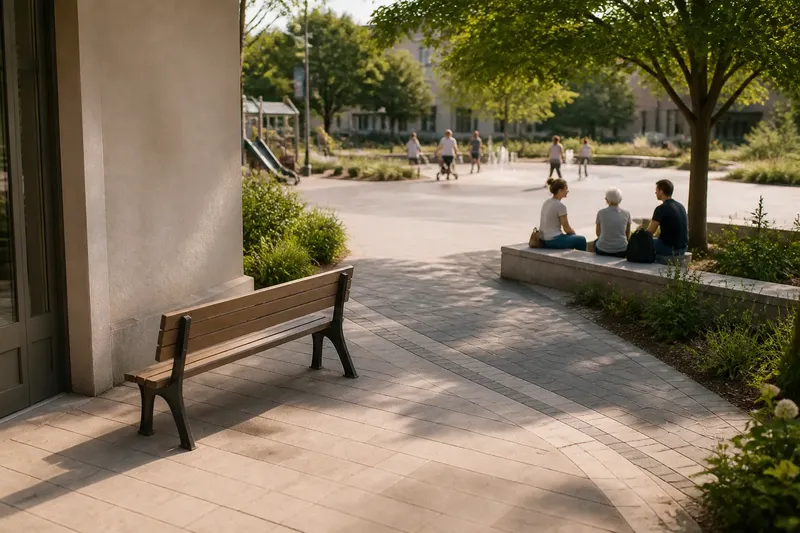
A planted retreat tends to offer pauses that are tied to particular spots. A bench facing a garden, a low wall beside a tree, or a small clearing off the path gives someone a reason to stay without occupying the route. Shade, foliage, and a view into the planting can make a short visit feel separate from nearby traffic, though the effect depends on actual maintenance and the surrounding buildings.
In an open square, a pause is often more exposed and less prescribed. People may stop at the edge, lean against a planter, stand in a loose group, or sit wherever movable furniture happens to be placed. The broad view makes companions easier to spot, but offers fewer visual screens from nearby activity.
Look for the difference between a destination and a pause point. A destination has a clear reason to stay, such as a garden view or a small play feature. A pause point simply lets someone stop briefly without blocking a through-route. Small spaces need both, but a planted layout often makes the first more legible, while an open layout makes the second easier to improvise.
Check whether a person can stop without standing in the middle of the main path.
Follow the routes people are likely to take
Paths through a pocket park often bend around planting or connect a few entrances by a defined line. That can slow a crossing and make the route feel like part of a visit rather than a shortcut. It can also make the available path feel narrow when people walk in opposite directions or gather near a feature.
An open square usually permits several lines of travel. Someone can cross diagonally, pass along an edge, or change direction as a group forms. This flexibility matters near shops, transit stops, or civic buildings, where people may be passing through for reasons that have little to do with the square itself.
Watch the entrances, not just the center. A planted bed placed between two doors can redirect foot traffic toward a narrower path; a clear paved line can preserve a direct connection. When a route appears to cross a space, consider whether the layout acknowledges it or merely hopes people will walk somewhere else.
Imagine a small lot between a library entrance and a bus stop. If the center contains connected garden beds and one curved path, a person hurrying to the stop may take the path’s edge or cut across the planting; replacing part of the center with a direct paved crossing would make that movement easier to read, while keeping planted seating bays at the sides could preserve quieter places to pause. The visible result to look for is whether the through-route and the staying areas can coexist without asking visitors to guess.
Read the edges before judging the middle
Edges help explain what a small public space is for. A pocket park may use hedges, low walls, tree trunks, or raised beds to make a sheltered boundary. These features can separate a sitting area from a busy sidewalk, but a dense or high edge may also hide the space from passersby or make an entrance hard to see.
A square often depends on its surrounding frontages and open approaches. Storefronts, building doors, and broad sidewalks can keep the perimeter active without adding much inside the paved area. If the edges are blank walls, parking entrances, or service doors, the square may remain visually open yet feel poorly connected to daily activity.
Look for several kinds of entry rather than assuming one grand entrance is enough. A narrow park with a visible opening at each end can feel easy to pass through. A square may be approachable from all sides, but furniture, temporary barriers, or a change in paving can still direct people toward only a few access points.
Also notice what the boundary asks visitors to do. A low planter can mark a sitting area without closing it off. A broad paved apron can invite people from a sidewalk into the square, while a tight gate-like opening can make an otherwise public place feel conditional.
Consider what gathering means in each layout
A pocket park can support small, informal groups that settle around a shared feature: a garden bed, a play element, or a cluster of seats. Planting helps distinguish one group’s area from another, but it can reduce the clear space available for a larger gathering. A group that grows may spill onto the path, where it competes with people passing through.
An open square can accommodate groups whose size or arrangement changes. A few people can stand together without choosing a designated room, and an event can use the clear surface without having to work around a dense planting scheme. That openness does not make every square suitable for every gathering; nearby entrances, circulation lines, shade, and the character of the surrounding buildings still shape how people behave.
Ask whether the layout supports a gathering that is planned or one that forms by accident. A planted retreat can make quiet, repeated use feel comfortable. A clear square can let a group assemble, disperse, or shift position without much reorganization. Neither purpose is automatically more public; the relevant question is which kind of shared use the place can handle without displacing ordinary visitors.
Compare the comfort people can actually find
Plants can offer shade, seasonal change, and a softer view, but the benefit depends on where they are and how they are cared for. A tree at the far end of a pocket park does little for someone using the sunny entrance. A planting bed that blocks sightlines may feel restful to one visitor and uncomfortable to another.
Hard paving can make an open square straightforward to cross and rearrange, but it may provide little relief from sun or wind. Trees, awnings, umbrellas, and building shade can change that experience without turning the square into a garden. A useful comparison is not whether one has more greenery, but whether comfort is available where people pause and along the routes they use.
Listen, too. A pocket park may soften some street noise while still picking up sound from a nearby road. A square can make conversation easy to see and hear, but hard surfaces may carry voices and footsteps across the space. Buildings, traffic, and the shape of the enclosure affect the result, so a quick visit at a quiet hour may not describe a busy period.
Which small public space fits the use?
Is a pocket park mainly for sitting?
Not necessarily. It can also provide a short walking route, a planted view, or a place for a small group to meet. Its paths and planting usually make a brief pause more central than a large, flexible gathering.
Can an open square feel quiet?
Yes, if its edges offer sheltered places to stop and its busiest crossing lines do not run through every sitting area. Quiet depends on surrounding activity as well as the shape of the paving.
Which layout is better for events?
A clear square generally leaves more room for gatherings that need changing arrangements. A pocket park can suit smaller activities, but its planted areas and paths may limit where a group can stand without interrupting circulation.
What should I notice on a short visit?
Watch where people pause, which lines they cross, and whether groups can form without blocking movement. Look at the entrances and shade as well as the center, since a well-shaped interior can still be awkward to reach or use.
Make the comparison on an ordinary visit
Visit at a time when the space is in normal use, not only during a special event. Stand near an entrance, then look across the center and along the edges. Notice whether people enter to stay, pass through, wait for someone, or use the space as a shortcut.
- Find the largest unbroken surface and note whether it supports crossing or gathering.
- Trace the most direct routes between entrances and nearby destinations.
- Identify places to pause that do not obstruct those routes.
- Check where shade, planting, and comfortable edges are available.
- Notice whether a small group can gather without taking over a path or entrance.
- Look for barriers, blank edges, or unclear openings that make access less obvious.
Use those observations to name the space’s strongest invitation, not to assign it a permanent label. A pocket park can function as a shortcut at the morning rush, and a square can become a quiet place when its surrounding streets settle. The main search phrase, pocket park or open square, is useful as a comparison, but daily use tells you whether the design’s invitation matches the life around it.
When judging a proposed change, ask what it would displace as well as what it would add. More planting may create a better pause but narrow a needed route; a larger paved area may help groups while making the only shaded seat feel exposed. The best small public space is often the one whose routes, pauses, and gathering areas are clear enough to share without requiring anyone to read the designer’s mind.