Why a Kerb Changes the Way a Street Is Read
Why a kerb changes the way a street is read: learn what its height, shape, gaps, and surface cues tell you about where walking and driving belong.
You step off the sidewalk to pass a delivery cart, then hesitate at the edge of the street. That small change in height is doing more than keeping rainwater in its channel: the kerb tells your feet, wheels, and eyes where one part of the street ends and another begins. Why a kerb changes the way a street is read becomes clear when you pay attention to the transition, not just the pavement on either side.
Read the edge as a boundary, not a wall
A kerb, also called a curb in American English, commonly separates the carriageway—the space intended for moving or parked vehicles—from the footway. Its raised face gives a clear physical and visual cue. Drivers can read it as an edge to stay behind; pedestrians can sense that the vehicle space is nearby even when traffic is quiet.
The boundary is not absolute. A kerb does not stop a vehicle, and it does not tell you by itself who has legal priority. It does, however, make the street’s layout legible at a glance, especially where the pavement materials and colors are similar.
Start by asking what the edge lets you infer, then check whether the rest of the street supports that reading.
Choose what to notice by the situation
The useful question is not whether every kerb looks the same. It is which feature matters where you are standing.
- On an ordinary block with a clear raised edge: Notice the kerb’s continuous line and the change in level. This is the clearest visual separation between footway and carriageway, though parked cars, street trees, or a wide driveway may interrupt it.
- At a driveway or loading entrance: Look for a lowered section, a sloping transition, or a break in the kerb. These usually indicate that vehicles cross the footway at that point; they do not turn the whole sidewalk into vehicle space.
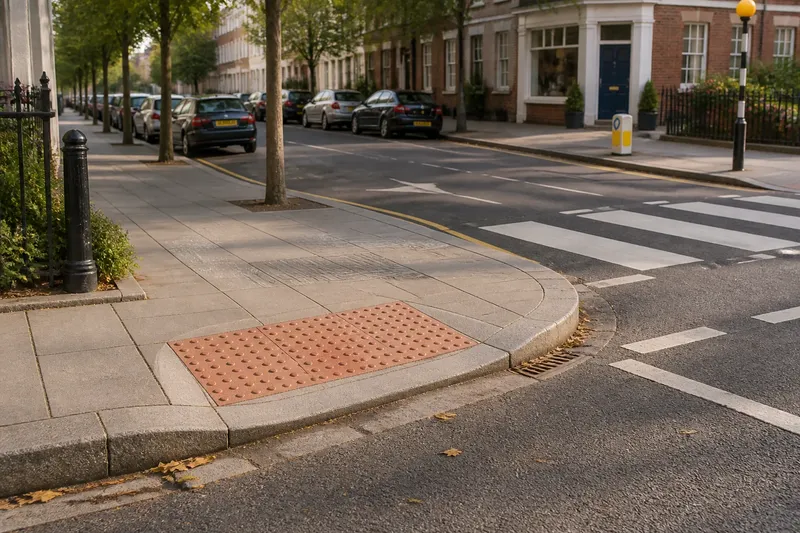
- At a street corner or marked crossing: Check how the kerb lowers and where the walking surface leads. A curb ramp can make the route usable for people who cannot step over a raised edge, while tactile paving may signal a change near the crossing. The intended path is easier to read when the ramp lines up with the crossing rather than pointing into the junction.
- Along a street with no raised edge: Use other cues, such as a drainage channel, paving change, bollards, parked vehicles, or a marked path. Without a distinct kerb, the division can be less obvious, so avoid treating the edge of the pavement as a reliable barrier.
- Beside a bike lane or planted strip: Notice whether the kerb separates pedestrians from moving traffic, cyclists, or both. A low separator may clarify the layout without providing the same protection as a taller, continuous edge.
Say you approach a corner where the sidewalk slopes down and tactile panels sit at its foot. The curb ramp suggests a crossing route; the panels draw attention to the transition, while the crossing markings and signal indicate how that route relates to traffic. Each cue answers a different question.
Look at height, continuity, and surface together
Kerb height affects how strongly the edge reads. A raised face is easy to see and feel, but it can be difficult for a wheelchair user, someone pushing a stroller, or a person using a cane to cross except at a ramp. A flush or nearly flush edge is easier to traverse, yet it may leave a less distinct boundary.
Continuity matters as much as height. A line interrupted by driveways still communicates the street’s basic arrangement, but repeated breaks can make the footway feel exposed to vehicles. At an intersection, an abrupt gap or a ramp aimed toward the wrong part of the roadway can make the intended crossing route harder to follow.
Surface changes add another layer. Different paving, tactile panels, paint, and drainage grates can help distinguish spaces, but each needs to be read in context: a color change alone may be decorative, while a tactile surface often carries a more specific warning or orientation cue. Look for several clues before deciding what the design is asking you to do.
Which kerb clues matter in common situations?
Does a lowered kerb mean vehicles have priority?
Not necessarily. A lowered section often allows vehicle access across the footway, but the surrounding signs, markings, and local rules determine how people should move there. Read it as a change in physical access, not as a complete statement about right of way.
Why do some corners have tactile paving?
Tactile paving provides a detectable surface cue, often near a crossing or other change in pedestrian route. Its placement and pattern matter; it is not simply a textured substitute for ordinary paving.
Can a low kerb still separate pedestrians from traffic?
It can mark the boundary clearly, particularly when paired with planting, posts, or a distinct surface. But a low edge offers less physical separation than a raised one, so the surrounding design matters to how protected the walking space feels.
What should I make of a kerb that disappears?
Check what takes over: a ramp, a driveway, a marked crossing, or an open roadway may each explain the break. If there is no clear continuation for walking, the transition may be ambiguous rather than intentional.
Separate a clear signal from a safe crossing
A legible boundary helps people understand the layout, but clarity is not the same as safety. A raised kerb can make a sidewalk unmistakable while leaving a difficult crossing nearby; a ramp can ease movement while still leading toward turning traffic or an awkward island.
For everyday street reading, follow the pedestrian route with your eyes from one side to the other. Notice where the kerb rises, falls, bends, or ends, then look for the crossing markings, signal, sightlines, and waiting space that complete the picture. Do not infer permission or protection from the kerb alone.
When the design seems inconsistent, report the specific location and the feature that causes confusion to the relevant local public works or transportation office. A precise description—such as a ramp that does not line up with the marked crossing—is more useful than a general complaint that the corner feels strange.
Why a kerb changes the way a street is read is ultimately a question of shared cues: height marks a threshold, continuity carries it along the block, and ramps or surface changes explain where people can cross it. On your next walk, trace that edge through one driveway and one corner. The point where its message changes is often the most informative part of the street.